Linked List
Introduction
Storing lists in datums is generally impractical, as their growth can lead to unspendable UTxOs due to limited resources available on-chain. A linked list is a construct for storing an infinitely large array of elements on-chain, such that each element is represented with a UTxO that points to its immediate successor.
Linked list structures leverage the EUTXO model to enhance scalability and throughput significantly. By linking multiple UTxOs together through a series of minting policies and validators, they improve the user experience when interacting with smart contracts concurrently.
Structure
Each element in the list is stored as a separate UTxO containing:
- NFT: A unique authentication token identifying the element
- Datum: An
Elementcontaining the element's data and a link (pointer) to the next element
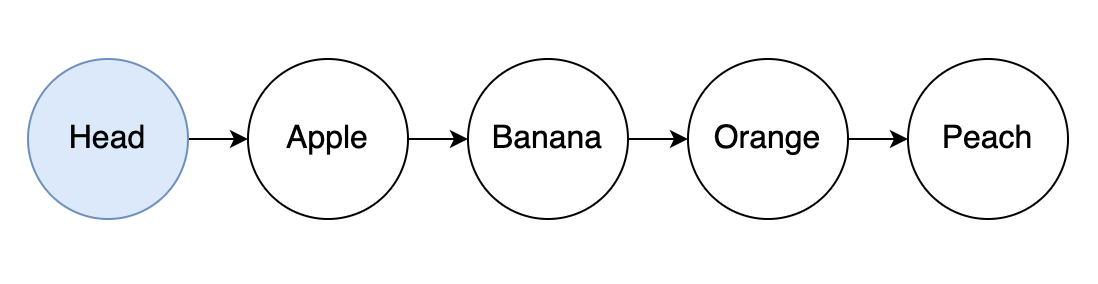
The list distinguishes between two kinds of elements:
- Root: The first element of the linked list, holding
root_data - Node: Any other element, holding
node_data
Each element's NFT asset name encodes its identity — the root uses a configurable RootKey, while nodes use a NodeKeyPrefix concatenated with their unique NodeKey.
Insertion
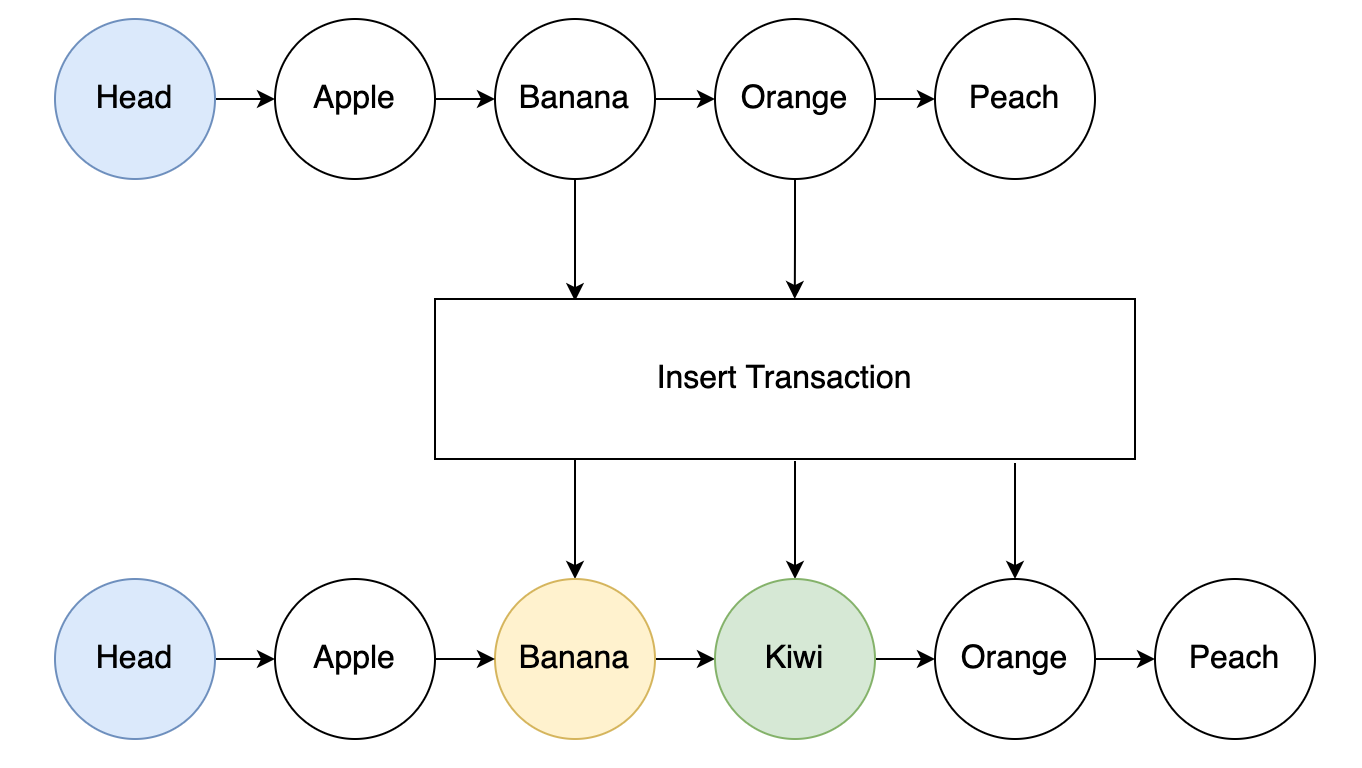
Inserting involves spending an existing anchor element and producing three UTxOs:
- The anchor element, updated to point to the new node
- The new node, pointing to what the anchor previously linked to
- For ordered lists, key ordering is validated automatically
Removal
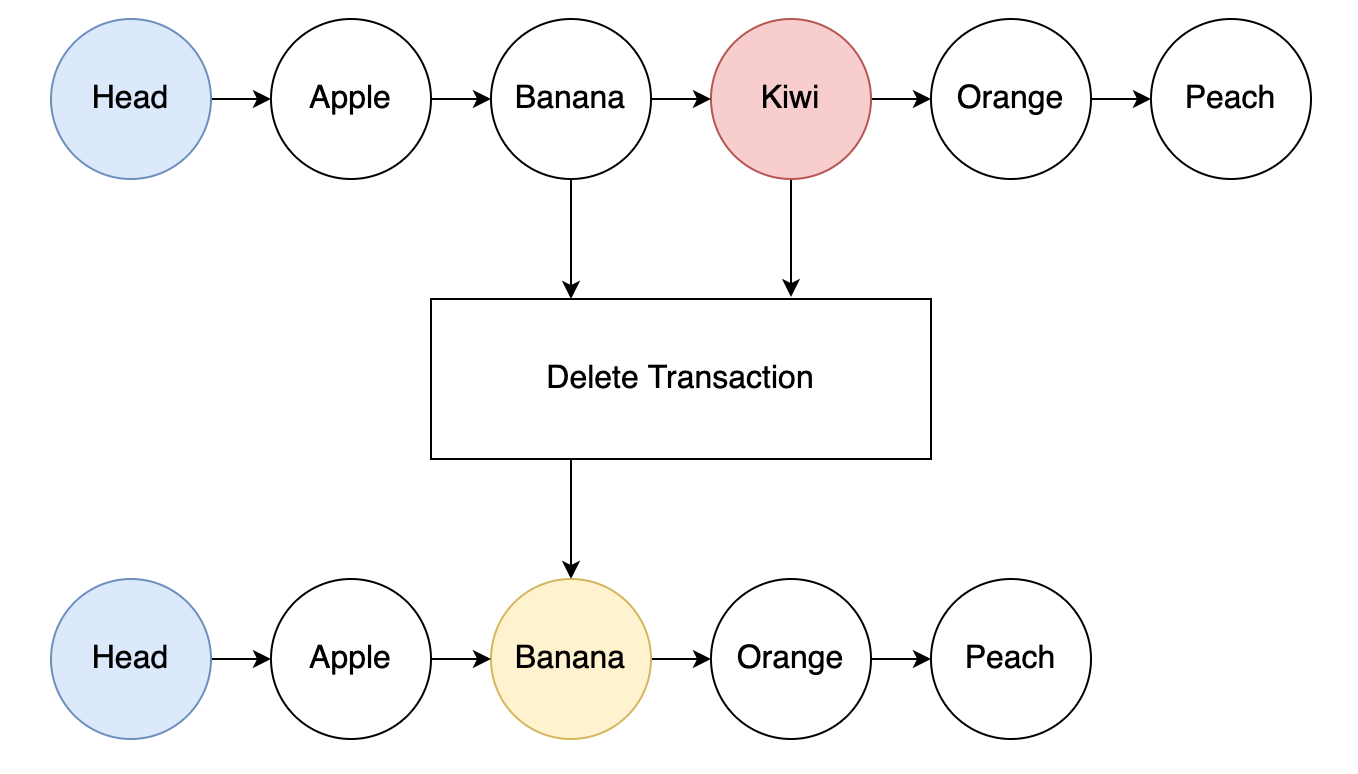
Removing a node requires spending both the node and its predecessor (anchor):
- The anchor element is updated to point to what the removed node was pointing to
- The removed node's NFT is burnt
NFTs as Pointers
NFTs serve as robust and unique pointers within the list. Their uniqueness is ensured by minting policies tied to the list's authentication policy. Each node's NFT asset name is derived from a prefix concatenated with its unique key.
Key Considerations
- Efficiency: On-chain lookups are inefficient; off-chain structures are recommended for indexing
- Security: List integrity is maintained through minting policies, datum validation, and NFT authentication
- No reference scripts: Elements are required to have no scripts attached to them, keeping the API manageable
- Address flexibility: While continued anchor nodes are validated to go to the same address, new/removed nodes only validate that payment credentials match, allowing customization of staking parts
Aiken Implementation
The API handles all linked list structural validations internally — pointer updates, key ordering, NFT minting/burning, and element authentication. Your contract only needs to provide application-specific validations through callback functions (additional_validations).
This is why the API does not expose granular helper functions, and only provides functions that perform primary linked list operations (e.g. init, insert_ascending, etc.). A good rule of thumb: if a validation is related to the linked list structure itself, the library has already taken care of it.
The implementation uses a Reader monad-style pattern where operations return Eval or RootEval functions that must be finalized with environment constants (policy ID, root key, node key prefix).
Key Types
/// The datum type for linked list UTxOs. Define your datum as:
/// pub type Datum = linked_list.Element<RootType, NodeType>
pub type Element<root_data, node_data> {
  data: ElementData<root_data, node_data>,
  link: Link,
}

pub type ElementData<root_data, node_data> {
  Root { data: root_data }
  Node { data: node_data }
}

/// Asset name of the root element's NFT (32 bytes max).
/// Keep in mind that some UTF-8 characters occupy more than 1 byte
/// (e.g. the tree emoji 🌳 takes up 4 bytes).
pub type RootKey = AssetName

/// Key for linked list nodes (at least 1 byte, at most
/// (32 - NodeKeyPrefixLength) bytes). Keys should be unique — the
/// recommended approach is to use the hash of an input's output
/// reference. If you need duplicate keys, proceed with extreme
/// caution as linked list integrity can break without other means
/// of preserving it.
pub type NodeKey = ByteArray

/// Bytes prefixing all node NFT asset names. Note that the total
/// bytes allowed for node NFTs is 32 at most, so if your prefix
/// occupies 4 bytes, keys can have 28 bytes at most.
pub type NodeKeyPrefix = ByteArray

/// Length of the NodeKeyPrefix in bytes. Use `const` to leverage
/// Aiken compiler optimizations and avoid computing the length
/// on-chain:
/// const node_key_prefix_length = bytearray.length(node_key_prefix)
pub type NodeKeyPrefixLength = Int

/// Pointer to the next element
pub type Link = Option<NodeKey>

/// Reader monad for operations that validate node key prefixes
pub type Eval =
  fn(PolicyId, RootKey, NodeKeyPrefix, NodeKeyPrefixLength) -> Bool

/// Reader monad for init/deinit (no node key prefix needed)
pub type RootEval =
  fn(PolicyId, RootKey) -> Bool

/// Reader monad with polymorphic return type
pub type ElementEval<a> =
  fn(PolicyId, RootKey, NodeKeyPrefix, NodeKeyPrefixLength) -> a
Initialization and De-initialization
init
Initialize a linked list by producing a root element UTxO with its authentication NFT.
pub fn init(
  nonce_validated: Bool,
  produced_element_output: Output,
  tx_mint: Value,
  root_validator: fn(Lovelace, Data) -> Bool,
) -> RootEval
nonce_validated: guardrail confirming nonce validation has been performedproduced_element_output: the output UTxO that will hold the root elementtx_mint: transaction's mint fieldroot_validator: callback to validate Lovelace count and root data
deinit
Destroy an empty linked list by spending and burning the root element.
pub fn deinit(
  root_input: Input,
  tx_mint: Value,
  root_validator: fn(Lovelace, Data) -> Bool,
) -> RootEval
root_input: the spent root element inputtx_mint: transaction's mint fieldroot_validator: callback to validate Lovelace count and root data
Element Addition
All addition functions validate NFT minting, pointer updates, address matching, and datum structure. The additional_validations callback receives context about the anchor element and the new node for application-specific checks.
insert_ascending
Insert a node maintaining ascending key order relative to the anchor element.
pub fn insert_ascending(
  anchor_element_input: Input,
  continued_anchor_element_output: Output,
  new_element_output: Output,
  tx_mint: Value,
  additional_validations: fn(
    LovelaceChange, Option<NodeKey>, Data,
    Lovelace, NodeKey, NodeData, Link,
  ) -> Bool,
) -> Eval
The additional_validations callback receives:
- Change in Lovelace count from anchor input to continued anchor output
- Anchor element's key (
Noneif anchor is root) - Underlying data of the anchor element
- Lovelace count of the new node UTxO
- Key of the new node
- Underlying data of the new node
- Link of the new node
insert_descending
Identical to insert_ascending, but the inserted key is expected to be less than the anchor's and greater than the anchor's link.
pub fn insert_descending(
  anchor_element_input: Input,
  continued_anchor_element_output: Output,
  new_element_output: Output,
  tx_mint: Value,
  additional_validations: fn(
    LovelaceChange, Option<NodeKey>, Data,
    Lovelace, NodeKey, NodeData, Link,
  ) -> Bool,
) -> Eval
append_unordered
Append a new element at the end of an unordered list. No key ordering is validated.
pub fn append_unordered(
  anchor_element_input: Input,
  continued_anchor_element_output: Output,
  new_element_output: Output,
  tx_mint: Value,
  additional_validations: fn(
    LovelaceChange, Option<NodeKey>, Data,
    Lovelace, NodeKey, NodeData,
  ) -> Bool,
) -> Eval
prepend_unordered
Prepend a new element at the start of an unordered list. The anchor must be the root element.
pub fn prepend_unordered(
  root_element_input: Input,
  continued_root_element_output: Output,
  new_element_output: Output,
  tx_mint: Value,
  additional_validations: fn(
    LovelaceChange, RootData,
    Lovelace, NodeKey, NodeData, Link,
  ) -> Bool,
) -> Eval
Element Removal
remove
Remove a node from the list. Expects two spent UTxOs: the node being removed and its anchor (predecessor) element.
pub fn remove(
  anchor_element_input: Input,
  removing_node_input: Input,
  continued_anchor_element_output: Output,
  tx_mint: Value,
  additional_validations: fn(
    LovelaceChange, Option<NodeKey>, Data,
    Lovelace, NodeKey, NodeData, Link,
  ) -> Bool,
) -> Eval
The additional_validations callback receives the same values as insert_ascending, but the NodeKey and NodeData refer to the node being removed.
Fold Operations
fold_from_root
Spend a root element and its linked node, reproduce the root while burning the node's NFT. Useful for accumulating data from nodes back into the root.
pub fn fold_from_root(
  anchor_root_input: Input,
  folding_node_input: Input,
  continued_anchor_root_output: Output,
  tx_mint: Value,
  additional_validations: fn(
    LovelaceChange, RootData,
    Lovelace, NodeKey, NodeData, Link, RootData,
  ) -> Bool,
) -> Eval
The additional_validations callback receives:
- Change in Lovelace count from input root to output
- Underlying data of the input root
- Lovelace count of the folding node
- Key of the folding node
- Underlying data of the folding node
- Link of the folding node
- Underlying data of the reproduced root
Data Updates
spend_for_updating_elements_data
Update an element's data without affecting the linked list structure. Uses the UTxO Indexers pattern for one-to-one input/output mapping.
pub fn spend_for_updating_elements_data(
  element_input_index: Int,
  continued_element_output_index: Int,
  element_input_outref: OutputReference,
  inputs: List<Input>,
  outputs: List<Output>,
  tx_mint: Value,
  additional_validations: fn(LovelaceChange, Option<NodeKey>, Data, Data) ->
    Bool,
) -> Eval
The additional_validations callback receives:
- Change in Lovelace count from input to output
- Possible node key (
Noneif element is root) - Input underlying data
- Updated data in the reproduced element
Helpers
spend_for_adding_or_removing_an_element
Checks if any tokens are being minted or burnt under the linked list's policy. Used in spending validators to gate structural operations.
pub fn spend_for_adding_or_removing_an_element(
  list_nft_policy_id: PolicyId,
  tx_mint: Value,
) -> Bool
get_element_info
Extract validated element information from a UTxO. Useful when another script needs to validate expenditure from the linked list.
pub fn get_element_info(
  element_utxo: Output,
  info_validations: fn(Lovelace, Option<NodeKey>, Data, Link) -> a,
) -> ElementEval<a>
The continuation receives:
- Lovelace count
- Possible node key (
Noneif root) - Underlying data
- Element's link
Finalization
Operations return Eval or RootEval values that must be finalized with environment constants. Define a helper like this:
use aiken_design_patterns/linked_list

const node_key_prefix = "NODE"

const node_key_prefix_length =
  bytearray.length(node_key_prefix)

pub fn finalize_linked_list(
  eval: linked_list.Eval,
  list_nft_policy_id: PolicyId,
  root_key: RootKey,
) -> Bool {
  linked_list.run_eval_with(
    eval,
    list_nft_policy_id,
    root_key,
    node_key_prefix,
    node_key_prefix_length,
  )
}
Then use it in your minting contract:
let linked_list_eval = insert_ascending(...)

expect linked_list_eval |> finalize_linked_list(own_policy_id, root_key)
The three finalization functions:
/// Finalize an Eval with all environment constants
pub fn run_eval_with(
  reader: Eval,
  list_nft_policy_id: PolicyId,
  root_key: RootKey,
  node_key_prefix: NodeKeyPrefix,
  node_key_prefix_length: NodeKeyPrefixLength,
) -> Bool

/// Finalize a RootEval (for init/deinit)
pub fn run_root_with(
  reader: RootEval,
  list_nft_policy_id: PolicyId,
  root_key: RootKey,
) -> Bool

/// Finalize an ElementEval with polymorphic return type
pub fn run_element_with(
  reader: ElementEval<a>,
  list_nft_policy_id: PolicyId,
  root_key: RootKey,
  node_key_prefix: NodeKeyPrefix,
  node_key_prefix_length: NodeKeyPrefixLength,
) -> a
Example Code
Library implementation: linked_list module
Test suite: linked_list tests
Acknowledgments
This documentation and the linked list implementation draw inspiration from original ideas presented in the Plutonomicon. For further details on the foundational concepts, see the Plutonomicon's Associative Data Structures Overview.